
Itasha History: How Japan’s Anime Car Culture Began
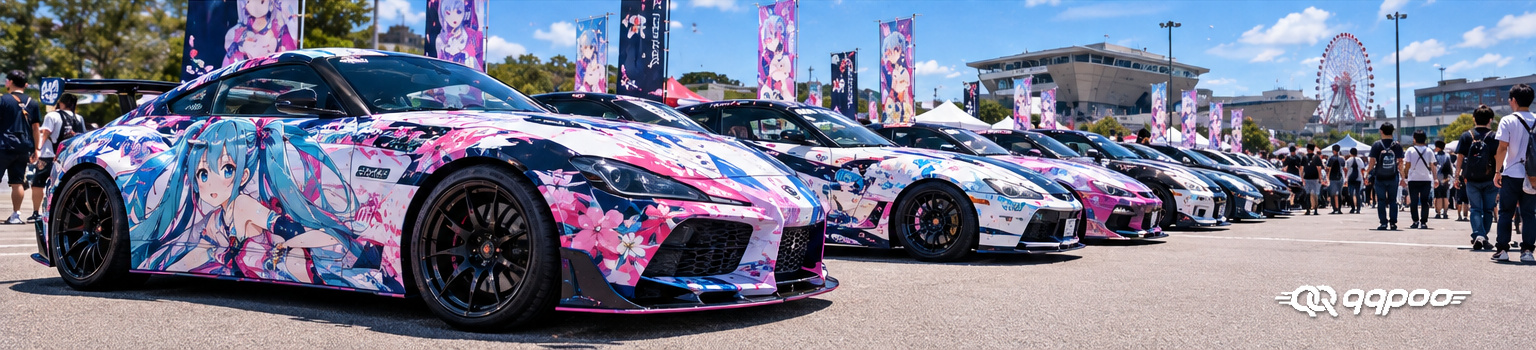
Itasha history begins with Japanese fans bringing their favorite characters into everyday car culture. The recognizable scene developed around the early 2000s, as personal vehicle decoration gained a wider community through online sharing, specialist magazines and gatherings. By 2008, reports documented dedicated displays, overseas enthusiasts and a Hatsune Miku motorsport project.
The sources below do not establish a single first car. A more useful origin story follows the people and connections that turned individual decoration into a shared hobby. For definitions and terminology, see our What Is Itasha? introduction.
Before the big wraps: fandom meets the personal car
The starting point was a familiar fan impulse: keeping a favorite character close. Stickers and character merchandise brought that attachment into a vehicle. Retrospective accounts often trace these precursors to the 1980s and 1990s, but personal decoration and an organized itasha scene are different milestones.
A contemporary account offers a firmer anchor. The December 2008 issue of Highlighting Japan, published by Japan’s Cabinet Office, places the emergence of customized itasha around 2000 and describes online communities and specialist magazines supporting its growth. This supports an early-2000s origin for the developing scene, without inventing an exact birthday. Read The World of Itasha, pp. 28–29.

How individual cars became a community
A decorated car becomes part of a scene when other owners recognize it, talk about it and want to take part. Online sharing could introduce an unfamiliar build; a gathering made it possible to meet the person behind it. Specialist magazines gave readers another way to discover vehicles beyond their immediate circle.
There is a useful period example. In July 2008, ASCII reported on the second volume of Itasha Graphics. Its contents included cars from across Japan, event reports and guidance for newcomers. The publication served existing owners and readers considering a first project. See ASCII’s July 31, 2008 report.
That combination helps explain the momentum: a striking car attracts attention, a photograph travels, and a reader becomes a participant. This is an interpretation of those community channels, rather than a claim that one website or magazine created itasha.
The late 2000s: a visible scene around fan events
By August 2008, itasha was documented as a public gathering rather than isolated customization. GIGAZINE photographed an Autosalone exhibition beside Comic Market 74. It showed vehicles featuring characters from several works, including Magical Girl Lyrical Nanoha, Touhou Project and Hatsune Miku. See GIGAZINE’s contemporary exhibition report.
The significance is the variety. Owners did not need to follow one franchise or reproduce one approved design to participate. Character-decorated vehicles brought different fandoms into the same space.
Separately, Highlighting Japan reported approximately 400 vehicles at November 2008’s ItaG Festival in Odaiba. Autosalone and ItaG Festival are distinct events; their names and attendance figures should not be mixed together. Source: Highlighting Japan, December 2008.
2008: character fandom enters professional racing
The Hatsune Miku GT Project is a clearly dated milestone. GOODSMILE RACING states that it launched in 2008 and competed in SUPER GT’s GT300 class. Its personal sponsorship system also began in 2008, allowing individual fans to support the racing effort. Source: GOODSMILE RACING official FAQ.
This joined two forms of participation: following a character and following a team through a season. A character-themed car could compete on track, while supporters could become involved beyond admiring the graphics.
Keep two dates separate: the project began in 2008; Racing Miku, its dedicated racing character, dates to 2010 according to the same official source. Neither is the invention date of itasha itself.
Itasha’s overseas story started early
On July 29, 2008, the Taipei Times covered enthusiasts in Taiwan and an association founded that February. Its photograph showed an owner’s car at the Fancy Frontier comics event in Taipei. Read the contemporary Taipei Times report.
This complicates a neat Japan-first, rest-of-the-world-much-later timeline. While the Japanese scene was gaining visibility in print and at events, enthusiasts elsewhere were already adapting the idea locally.
The transferable part was the relationship between a fan, a character and a personal vehicle. A community could adopt that relationship without copying every detail of a Japanese event or owning the same model of car.
A short itasha history timeline
- Around 2000: A contemporary 2008 account places customized itasha’s emergence around this period.
- July–August 2008: Reports document enthusiasts in Taiwan, specialist Japanese publishing and an Autosalone display beside Comic Market 74.
- November 2008: ItaG Festival in Odaiba attracts approximately 400 vehicles.
- 2008: The Hatsune Miku GT Project begins.
- 2010: Racing Miku becomes the project’s dedicated racing character.
Frequently asked questions
Who invented itasha?
The sources cited here do not establish a single inventor. They describe a fan-driven practice that became an organized scene through owners, community media and events.
Did itasha start with Hatsune Miku racing?
No. The 2008 racing project is a motorsport milestone within an existing culture. Its launch date should not be mistaken for the origin date of all itasha.
Are today’s full wraps what early itasha always looked like?
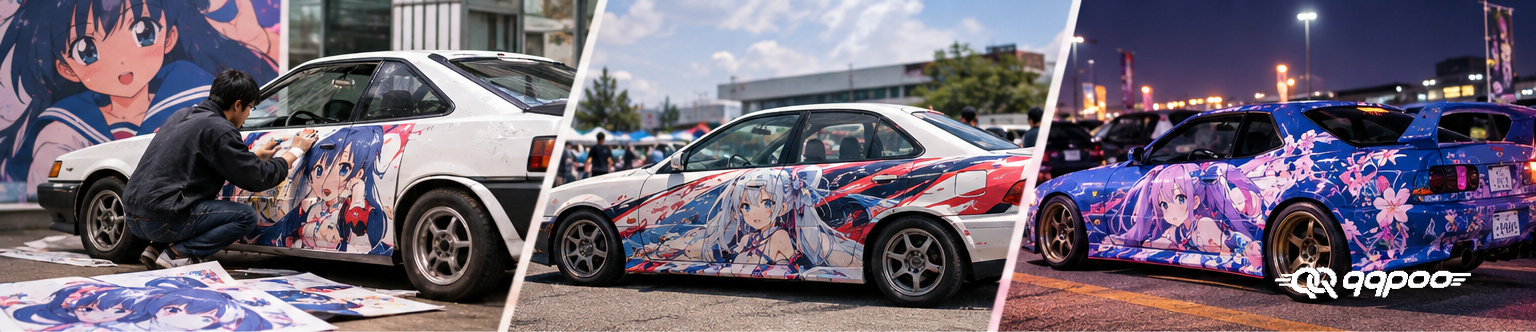
No. Period reporting shows varied approaches to character decoration. A modern full-wrap image should not be presented as evidence of exactly how an earlier owner’s car looked.
What the origin story leaves us with
The lesson from itasha history is that community grew around personal choices. Events, magazines and racing expanded the audience, but the owner’s connection to the artwork remained central.
For a new build, start with the character or story you want to express, then consider how it belongs on your particular car. Explore our custom itasha design information when you are ready to turn that idea into a design brief.